

Ligonier Junk Podcast Episode 002: How to get started cleaning out your spaces
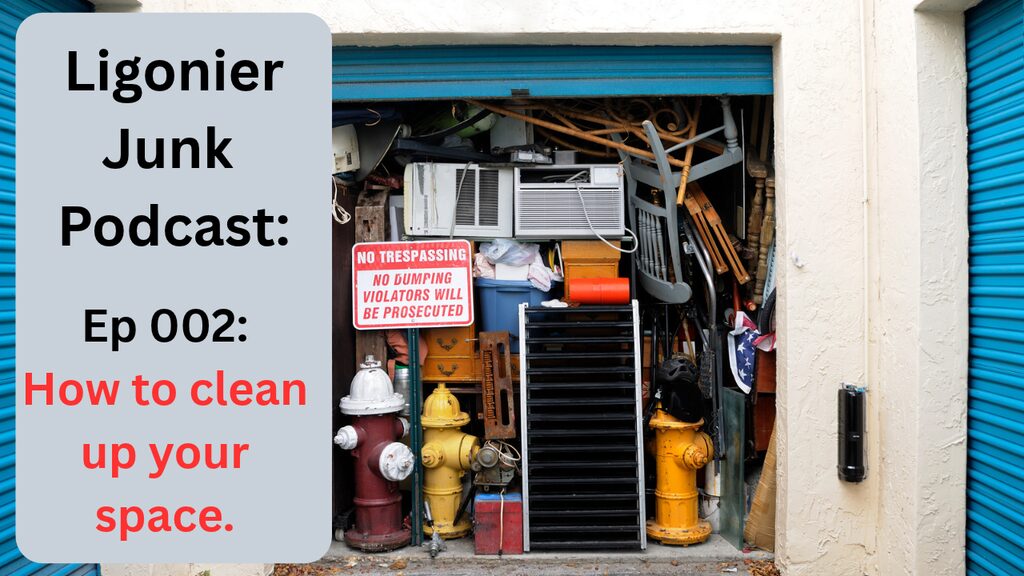
Your Junk Is Stealing More Than Space
Approx. 0:00–1:15
Let me ask you a question.
How much of your house do you actually use… and how much of it has slowly turned into a storage unit for things you don’t even want anymore?
Maybe you have a garage you can’t park in.
Maybe your basement is full of furniture you’ve been meaning to get rid of for five years.
Maybe there’s a treadmill in the corner that has become a very expensive clothes rack.
Or maybe you’ve got a shed, a spare bedroom, or an entire house full of stuff, and every time you think about cleaning it out, you decide that today is probably not the day.
If that sounds familiar, you’re not alone.
Here’s the thing: clutter doesn’t just take up physical space. It takes up mental space, too. Every time you walk past that pile, you get a little reminder of something you haven’t finished. Something you need to deal with. Another project waiting for you.
And the longer it sits there, the easier it becomes to ignore it.
But what if getting rid of that stuff didn’t have to be a massive weekend project that leaves you exhausted, frustrated, and wondering why you started?
Today, we’re going to talk about three simple steps to reclaim your space.
First, how to stop feeling overwhelmed and actually get started.
Second, how to decide what stays, what goes, and what deserves a second life.
And third, how to get the stuff out of your house without turning the cleanup into another giant project.
And stick around for the third step, because there’s a simple way to make the whole process easier that a lot of people overlook.
I’m talking about this because we work with homeowners throughout Ligonier and the surrounding communities, and we know that sometimes the hardest part isn’t the junk itself. It’s figuring out where to begin.
We’re Ligonier Junk, and our goal is to help you take your space back.
Let’s start with the biggest obstacle.
TOPIC 1 — Stop Trying to Clean Everything at Once
Approx. 1:15–3:45
Here’s the first mistake people make when they decide to clean out a garage, basement, or spare room.
They think they have to do the whole thing.
They look at a garage that’s been accumulating stuff for ten years, and they imagine a perfect, organized garage by Sunday afternoon.
So they pull everything out, start sorting, find things they forgot they owned, get distracted by an old project, and suddenly the driveway is full of stuff.
It’s getting dark. They’re exhausted. And now the garage is somehow worse than when they started.
Sound familiar?
The problem isn’t necessarily a lack of motivation. It’s that the project is too big and too vague.
So here’s my first recommendation: stop thinking about cleaning out the entire space. Think about reclaiming one specific piece of it.
Maybe it’s the walkway to your workbench.
Maybe it’s enough room to get your car inside before winter.
Maybe it’s that corner of the basement where you want to set up a work area.
Choose one concrete outcome.
Then divide the project into manageable sections.
If you’re working on a garage, start with the old furniture along one wall. Or the broken equipment in the back corner. If you’re working on a basement, start with one room or one clearly defined area.
Give yourself a reasonable time limit. Even 20 or 30 minutes can make a difference.
The goal isn’t to finish everything in one heroic burst of effort. The goal is to make real progress without creating an even bigger mess.
And here’s another trick: start with the big, obvious items.
That broken recliner. The old exercise bike. The damaged shelving. The furniture you’ve already decided you’re never going to use again.
Removing a few large items can open up a surprising amount of space. Suddenly, you can see the floor. You can reach the shelves. You can actually move around.
And that visual progress can give you the motivation to keep going.
Now, there’s one important distinction here.
Don’t start hauling everything into the driveway unless you have a plan for where it’s going afterward. Otherwise, you may simply relocate your clutter from one place to another.
Start small, make decisions, and move things toward their final destination.
And if you discover that the project is bigger than you can reasonably handle, that’s okay, too. You don’t get extra points for spending your entire weekend carrying heavy furniture down basement stairs.
Sometimes the smartest move is getting some help.
At Ligonier Junk, we help with everything from a few bulky items to garage cleanouts, basement cleanouts, furniture removal, appliance removal, shed removal, and larger property cleanouts.
You can reach us at 724-205-7697, or visit LigonierJunk.com to learn more about our services.
But before you start hauling anything away, there’s another problem to solve.
What do you actually want to get rid of?
That’s step two.
TOPIC 2 — The Four-Pile Rule: Keep, Give Away, Remove, and Decide
Approx. 3:45–6:35
One of the biggest reasons cleanout projects drag on for months or even years is that people don’t have a simple system for making decisions.
They pick something up, look at it, remember where it came from, wonder whether they might need it someday, and put it back down.
Then they do the same thing with the next item.
And the next one.
Pretty soon, they’ve spent two hours rearranging their belongings without actually getting rid of anything.
So here’s a simple system you can use.
As you go through your space, put each item into one of four categories.
Pile number one: Keep.
These are things you genuinely use, need, or value.
Not things you feel guilty about throwing away. Not things you might theoretically use if you completely changed your lifestyle.
Things that have a real purpose in your life.
Pile number two: Give away or sell.
Maybe that old table is still in good shape. Maybe the exercise equipment works. Maybe you’ve got tools, chairs, household goods, or other belongings that someone else could use.
If an item has useful life left in it, consider whether someone else could benefit from it.
You might sell something valuable, offer it to a neighbor, or find an appropriate donation option.
And here’s a little bonus: if you have something useful that you don’t need, you might be able to make somebody else’s day by passing it along.
That’s one reason we like finding new homes for useful items whenever practical. One person’s unwanted furniture might be exactly what another person has been looking for.
Pile number three: Remove.
This is the broken furniture, damaged items, old appliances, unusable equipment, and miscellaneous stuff that has reached the end of its useful life.
Some things may be recyclable. Others need appropriate disposal. The important part is that they no longer need to occupy your home.
And remember, not everything needs to go into a regular trash can. Paint, chemicals, fuels, batteries, and certain electronics may require special handling or designated disposal locations.
Set those items aside and check the appropriate local disposal requirements rather than mixing them in with ordinary household junk.
Pile number four: Decide.
Now, I know what you’re thinking.
Didn’t we just say indecision was the problem?
Yes. And this is where you need to be careful.
A small number of items really do deserve more thought. Maybe it’s something inherited from a family member. Maybe it’s an expensive tool you haven’t used recently. Maybe it’s a box of photographs.
You don’t need to rush through meaningful decisions just to finish a cleanout.
But give this category a limit.
Put those items in one clearly defined box or area, and give yourself a specific date to revisit them.
Otherwise, the entire garage becomes a permanent “decide later” pile.
Here’s a question I find helpful when deciding whether something deserves to stay:
If I didn’t already own this item, would I spend money, time, and effort to bring it into my home today?
If the answer is no, ask yourself why you’re keeping it.
Sometimes the answer is perfectly legitimate. Sentimental value matters. Seasonal equipment matters. Emergency supplies matter.
But sometimes we keep things simply because they’re already there.
And that can be an expensive habit when you consider the space those things occupy.
Think about a spare bedroom that hasn’t been usable for years because it’s full of boxes. Or a garage where you can’t park your car. Or a basement that could be a workshop, playroom, or useful storage area if you could actually get to it.
The cost of clutter isn’t just the money you spent buying the stuff. It’s also the useful space you’re giving up.
So here’s a question for you.
What’s the one item in your house that you have been meaning to get rid of forever?
Maybe it’s a couch. Maybe it’s a refrigerator that doesn’t work. Maybe it’s an old shed, a pile of scrap wood, or that treadmill we talked about earlier.
Drop it in the comments. We’d love to hear what people around Ligonier are trying to clear out.
And if you’re sitting there thinking, “I’ve got a whole lot more than one item,” don’t worry. That’s exactly why junk removal exists.
Once you’ve decided what stays and what goes, the next challenge is getting it out of there.
And that’s where step three comes in.
TOPIC 3 — Don’t Let Getting Rid of Junk Become Another Job
Approx. 6:35–8:55
Let’s talk about the part people often underestimate.
Getting rid of the stuff.
Deciding you don’t want something is one thing. Actually removing it from your property is something else entirely.
You have to figure out how to move it. You might need another person to help. You may need a truck or trailer. Then there’s the question of where to take everything.
Can it go in your regular trash? Does it need to be recycled? Is there a disposal fee? Will the facility even accept it?
And what happens when you discover that the old couch is much heavier than you remembered, or that the refrigerator won’t fit through the doorway without some creative maneuvering?
Suddenly, your simple cleanup project has become a logistics operation.
That’s why it’s worth deciding early how you’re going to get rid of the things you no longer want.
If you’ve only got a few small items, handling it yourself may be perfectly reasonable.
If you’ve got usable belongings, you may be able to donate them or pass them along to someone who needs them.
And if you’ve got a substantial pile of junk, bulky furniture, appliances, or an entire garage or basement to clear, professional junk removal may save you a lot of time and effort.
The real advantage isn’t just having someone haul things away.
It’s not having to organize every step yourself.
You don’t have to borrow a truck, recruit your brother-in-law, figure out where everything goes, and spend your Saturday making multiple trips.
You can focus on deciding what you want to keep, what you want to remove, and what you want the space to become.
Then you can get help with the physical removal.
At Ligonier Junk, we help homeowners and property owners in Ligonier and nearby communities with unwanted furniture, appliances, basement and garage cleanouts, shed removal, yard debris, and larger property cleanouts.
Sometimes it’s a single item that’s been sitting in the garage for too long.
Sometimes it’s years of accumulated belongings.
And sometimes you’re dealing with a property that needs a much bigger reset.
The point is to find an approach that fits the job.
One thing worth remembering: you don’t necessarily have to finish sorting every single box before asking for an estimate. If you’re unsure what the project involves, describe what you’re dealing with and ask what options are available.
A good first step is simply identifying what needs to go and how much space it occupies.
And if you’re in the Ligonier area, you can call 724-205-7697 or visit LigonierJunk.com to get in touch with Ligonier Junk.
We’ll help you figure out the next step.
Now, before we wrap up, there’s one last thing I want you to consider.
Because the real goal isn’t just getting rid of junk.
It’s getting your space back.
CALL TO ACTION CLOSE — What Would You Do With the Space?
Approx. 8:55–10:00
Imagine walking into your garage and actually being able to find what you’re looking for.
Imagine opening the basement door without feeling like you’re walking into a project you don’t have time to finish.
Imagine having a spare room you can use for guests, hobbies, exercise, or whatever matters to your family.
That’s what this is really about.
It’s not about having a perfect house. It’s not about throwing away everything you own. And it’s certainly not about making your home look like a magazine.
It’s about making your space work for you again.
So here’s my challenge to you.
Pick one area of your home that you’ve been avoiding.
Not the entire house. Not every closet, every shelf, and every storage box.
Just one area.
Decide what you want that space to become. Identify the things that are preventing you from getting there. And take one step toward clearing them out.
If you can do the job yourself, great.
If you need a hand with the heavy lifting, the bulky items, or a bigger cleanout, that’s what we’re here for.
Ligonier Junk serves Ligonier and surrounding communities, helping homeowners and property owners clear unwanted items and reclaim useful space.
Give us a call at 724-205-7697.
You can also visit LigonierJunk.com to learn more about our services and get in touch.
And if you enjoyed this video, here’s how you can help us out.
Give it a like, share it with somebody who has a garage full of stuff they’ve been meaning to get rid of, and leave us a comment telling us what space you’d most like to reclaim.
Is it the garage? The basement? The shed? An entire house?
We want to hear about it.
We’re Ligonier Junk, and we’re here to help you get that junk out of the way so you can get back to enjoying your space.
Thanks for watching, and we’ll see you in the next video!
Ligonier Junk — 724-205-7697 — LigonierJunk.com.
Now go reclaim some space.
Master Your Next Cleanout Project Today
This section encourages residents in Ligonier, PA to listen, subscribe, and learn expert clutter management strategies. It highlights the benefits of efficient hauling and offers clear instructions for engagement.